
Colour and Form
Fine art has always been a dialogue between material and light. Whether through the transparency of oil glazes, the density of acrylic, or the reflective surface of metal, every medium shapes the way colour reaches the viewer. What we perceive as luminosity in a painting is never the pigment alone. It is the interaction between the material, the surface, and the light that falls upon it.
For much of the twentieth century, textile and fibre were excluded from this conversation entirely. Galleries showed painting and sculpture; fibre belonged to ethnographic museums and cultural institutions far from the contemporary art world. That changed in the 1960s and 1970s when artists such as Lenore Tawney, Sheila Hicks, and Magdalena Abakanowicz demonstrated that thread and wool could carry conceptual and emotional weight equal to any bronze or oil on canvas. In North America the movement gained institutional recognition through landmark exhibitions at the Museum of Modern Art, and today fibre works hang in the permanent collections of the Smithsonian, the Art Institute of Chicago, and the National Gallery of Canada. The question is no longer whether fibre qualifies as fine art. It is what fibre can do that other media cannot.
The answer lies in depth. A felted surface is not flat. It is a landscape of interlocking wool and silk fibres, each catching and scattering light at its own angle. Where a painted canvas holds colour on a single plane, a felted work holds colour within its body. Layers of fibre blend optically rather than chemically: a strand of crimson crossing a strand of gold produces warmth not by mixing but by coexisting, much as the pointillists once placed dots of pure colour side by side and trusted the eye to complete the image.
Each technique contributes its own register. Nuno felting bonds wool to silk, creating translucent passages where light passes through the cloth and returns softened. Wet felting compresses fibres into dense, matte fields that absorb light and deepen tone. Fabric painting adds precision, sharp edges and controlled gradation atop the textured ground. In the hands of an artist who understands these forces, colour is not applied to a surface but built into it, and the boundary between image and object quietly disappears.
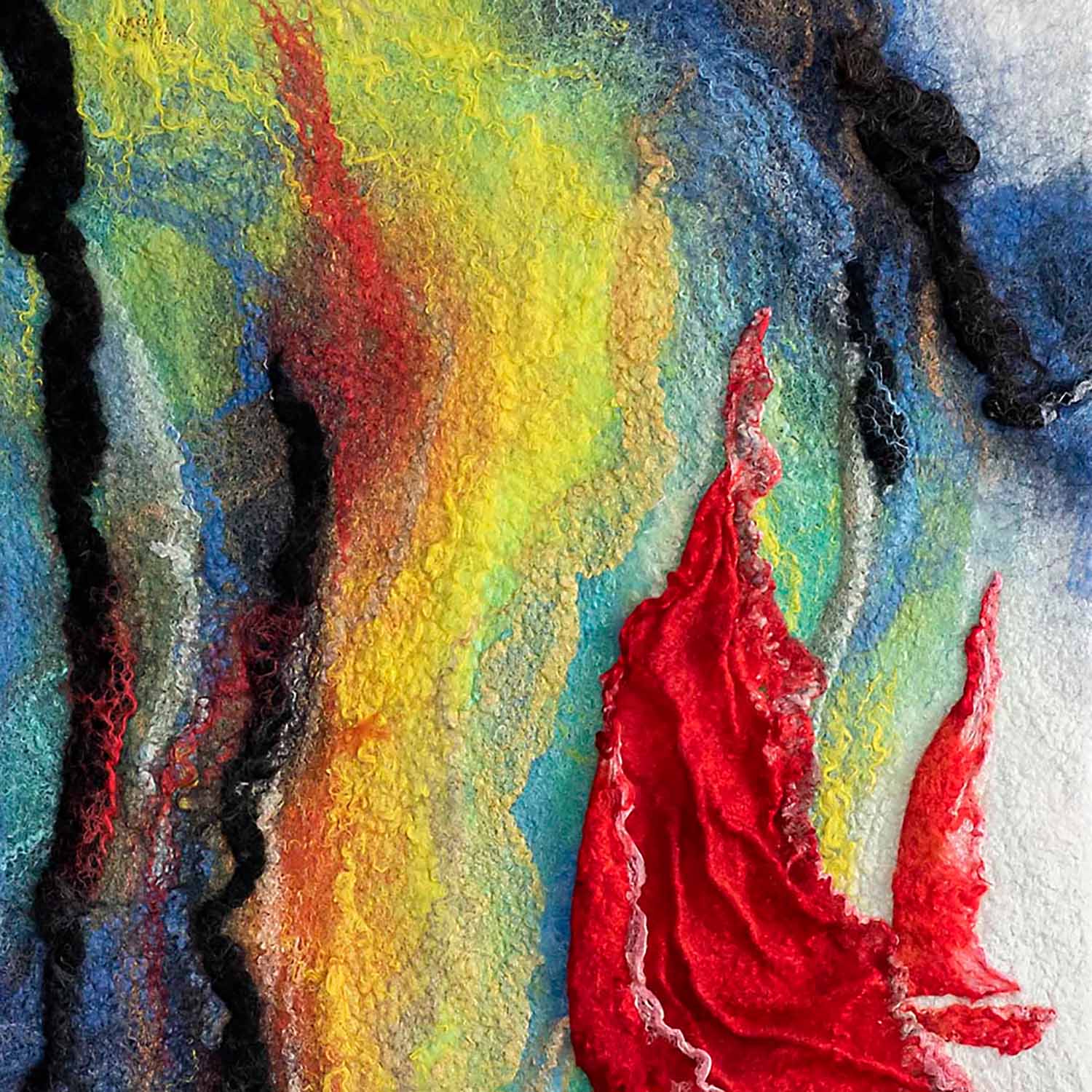
Regatta. Splashy Abstract 4
by Svetlana Turov

Regatta. Splashy Abstract 1
by Svetlana Turov

Regatta. Splashy Abstract 3
by Svetlana Turov